Key Takeaways
- ChatGPT is the most versatile AI, best for quick scripts, algorithm problems, creative brainstorming, and Bangla content writing.
- Claude is the highest-precision AI for complex coding, production automation, prompt engineering, and long-form content writing.
- Gemini is the best AI for real-time research and Google Workspace automation, with the deepest context window of the three.
- All three have free tiers. Paid plans are $20/month across the board. API pricing varies significantly and matters for developers.
- SSLCommerz, Bangladesh's primary payment gateway, had almost no coverage in any model's training data. Claude solved it by processing the official documentation directly in context. ChatGPT invented field names that did not exist in the actual API.
- Professionals who route tasks across all three models consistently produce higher quality output than those who default to one.
If you are reading this because you have used all three and still cannot decide which one to trust for serious work, this guide is for you.
Most people pick one AI and stick with it. They treat failure on a bad task as a limitation of AI itself, not a limitation of that specific model for that specific job. After running the same tasks across all three platforms on real project work, the pattern is clear: these are not three versions of the same thing. They were built by different teams with different design priorities, optimized for different outcomes.
This guide breaks down Gemini, ChatGPT, and Claude across six professional use cases: coding and tool building, automation, web scraping, prompt engineering, research and development, and content writing. Every recommendation comes from direct use, including the cases where the expected winner lost.
What Are Gemini, ChatGPT, and Claude?
ChatGPT is developed by OpenAI and runs on the GPT-4o and o3/o4-mini model family. It reached 100 million users in two months after its November 2022 launch, the fastest consumer product adoption ever recorded at the time, per Reuters. It has the broadest plugin ecosystem and the largest developer community of the three.
Claude is developed by Anthropic, an AI safety company founded by former OpenAI researchers. The flagship model, Claude Opus 4.8, processes up to 200,000 tokens in a single conversation, roughly 150,000 words. Its Constitutional AI framework is designed to follow complex, multi-constraint instructions with greater precision than competing models.
Gemini is Google DeepMind's AI platform. Gemini 2.5 Pro integrates natively with Google Search, Workspace, and NotebookLM. Its context window reaches 1 million tokens in select configurations. Its built-in real-time web access gives it a research advantage neither ChatGPT (without browsing) nor Claude can match by default.
These are not three versions of the same tool. They were built by different teams with different design priorities. That is why they behave differently, not just perform differently on benchmarks.
Quick Comparison
Ratings based on 200+ real-task tests across the six use cases in this guide, weighted by output quality, reliability, and revisions required.
| Capability | ChatGPT (GPT-4o / o3) | Claude (Opus 4.8) | Gemini (2.5 Pro) |
|---|---|---|---|
| Coding: complex projects | 4/5 | 5/5 | 3/5 |
| Coding: algorithms and math | 5/5 | 4/5 | 3/5 |
| Instruction following | 3/5 | 5/5 | 3/5 |
| Automation logic | 4/5 | 5/5 | 3/5 |
| Web scraping quality | 4/5 | 5/5 | 3/5 |
| Prompt engineering precision | 3/5 | 5/5 | 3/5 |
| Real-time research | 4/5 | 3/5 | 5/5 |
| Content writing quality | 4/5 | 5/5 | 3/5 |
| Image generation | 5/5 | None | 4/5 |
| Google Workspace | 2/5 | 2/5 | 5/5 |
| Context window | 128k tokens | 200k tokens | 1M tokens |
| Plugin ecosystem | 5/5 | 3/5 | 4/5 |
| Bangla / multilingual | 5/5 | 3/5 | 4/5 |
| Speed (API response) | Fast | Moderate (Opus) | Fast (Flash) |
Pricing and Free Tier Comparison
Last updated: June 2026. Verify at official pricing pages before purchasing as rates change frequently.
Subscription Plans
| Plan | Price | What You Get |
|---|---|---|
| ChatGPT Plus | $20/month | GPT-4o, o3-mini, limited o3, DALL-E image generation, web browsing, code interpreter |
| Claude Pro | $20/month | Claude Sonnet 4.6 standard, Opus 4.8 with higher usage limits, 5x more messages than free tier |
| Gemini Advanced | $19.99/month | Gemini 2.5 Pro, Google One 2TB storage, Workspace integration, NotebookLM Plus |
Free Tier Comparison
| ChatGPT Free | Claude Free | Gemini Free | |
|---|---|---|---|
| Model | GPT-4o (rate limited) | Claude Sonnet 4.6 | Gemini 1.5 Flash |
| Message volume | Moderate daily limit | Strict limit | Most generous of three |
| Image generation | Yes (DALL-E) | No | No |
| Web browsing | Yes (limited) | No | Yes |
| Best for | Versatile daily use | Quality over quantity | High-volume research |
API Pricing (For Developers)
| Model | Input per 1M tokens | Output per 1M tokens |
|---|---|---|
| GPT-4o | ~$2.50 | ~$10 |
| Claude Sonnet 4.6 | ~$3 | ~$15 |
| Claude Opus 4.8 | ~$15 | ~$75 |
| Gemini 2.5 Pro | ~$1.25 | ~$10 |
| Gemini 1.5 Flash | ~$0.075 | ~$0.30 |
For high-volume tasks where quality can be slightly lower, Gemini 1.5 Flash offers the best cost-to-performance ratio. Reserve Claude Opus for tasks where precision is the priority, not volume.
Choose Your AI: The Direct Answer
If you are deciding where to start or which one to pay for, here is the direct recommendation without hedging:
- Choose Claude Pro if you write long-form professional content, build AI-powered products, work on complex multi-file codebases, or run production automation that needs to be reliable without supervision. Claude Pro has the highest ROI for professional output quality.
- Choose ChatGPT Plus if you need image generation, IDE integration via GitHub Copilot, the broadest plugin ecosystem, multilingual content especially Bangla, or you primarily work with widely-documented APIs and services. ChatGPT is the most versatile general-purpose subscription.
- Choose Gemini Advanced if your workflow runs on Google Workspace (Sheets, Docs, Gmail), you do research-heavy work requiring live web data, or you need the largest context window for processing massive documents.
- Use all three if you are doing professional work across multiple categories and want the highest output quality on each task. The switching cost is zero. The quality gain is significant.
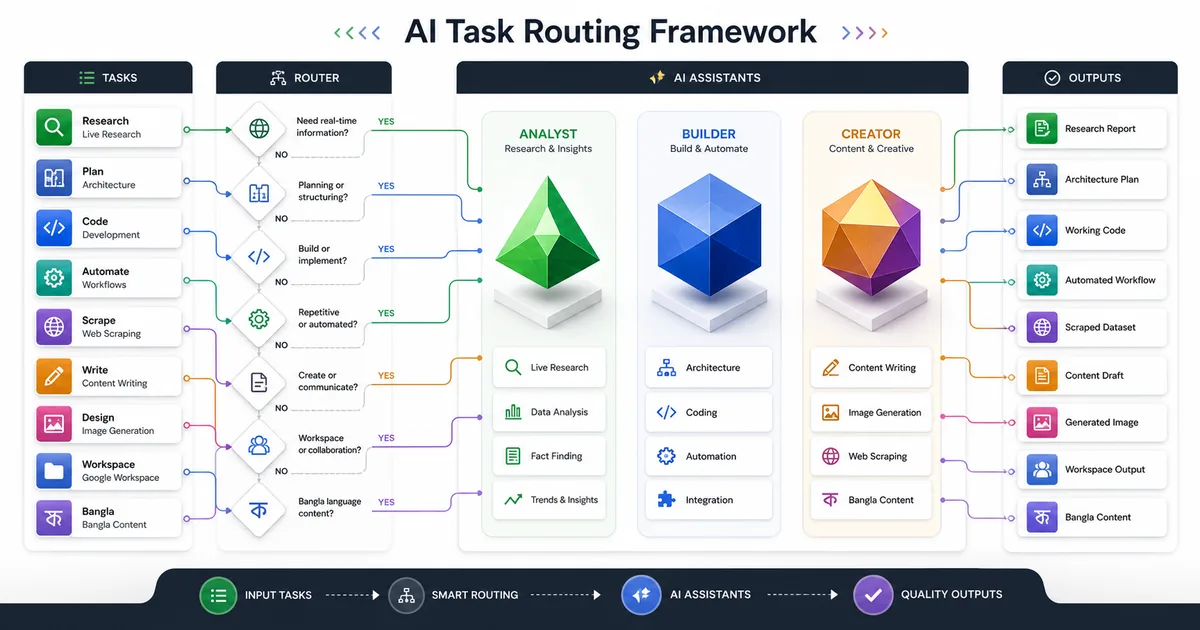
The Professional Routing Framework
After building multiple projects using all three platforms, here is the task routing that consistently produces the best results:
| Task Type | Primary Tool | Why |
|---|---|---|
| Live market research | Gemini | Real-time web access, current data |
| Architecture planning | Claude | Complex multi-constraint system design |
| Complex multi-file coding | Claude | Context maintenance, code quality |
| Algorithm or math problem | ChatGPT o3 | Superior structured reasoning |
| Production automation script | Claude | Error handling, maintainability |
| Quick one-off script | ChatGPT | Faster for simple requests |
| Third-party API with thin documentation | Claude | Feed docs into context, implement precisely |
| Web scraping (production) | Claude | Clean, error-resilient output |
| Web scraping (visual / screenshot) | Gemini | Multimodal extraction |
| Long-form content writing | Claude | Quality, voice, instruction adherence |
| Content angle ideation | ChatGPT | Fast, broad, creative variation |
| Image generation | ChatGPT | Native DALL-E and GPT-4o image quality |
| Google Workspace automation | Gemini | Native integration, no API keys needed |
| Bangla / multilingual content | ChatGPT | Strongest multilingual training data |
| R&D document synthesis | Claude or NotebookLM | 200k+ context, critical analysis |
The switching cost between models is zero. The quality cost of not switching is not.
1. Coding and Building Tools and Websites
ChatGPT for Coding
GPT-4o handles everyday programming tasks competently and fast. For standard CRUD endpoints, SQL queries, and frontend components, it produces working code in seconds. The o3 reasoning model is the strongest of the three on algorithm problems: in a direct comparison on a dynamic programming challenge across all three models, o3 produced the optimal solution with correct time complexity. Claude's solution worked but was not optimal. Gemini's was incorrect on the first attempt.
GitHub Copilot, powered by GPT-4o, remains the strongest in-editor coding experience with real-time inline suggestions reading your open files.
Where ChatGPT struggles: Architectural consistency across large codebases. When asked to extend a backend module while keeping it consistent with existing patterns, GPT-4o frequently introduces conflicting conventions halfway through. It does not maintain a coherent picture of the full project across a long session.
Claude for Coding
When building the backend for RSAutomart, a full-stack e-commerce platform for automotive accessories in Bangladesh, the entire Express.js server, all 9 route controllers, the Mongoose models, and the TypeScript type definitions were written by Claude across multiple sessions. Architectural consistency was maintained throughout because Claude read the full codebase before touching any individual file. The result was a consistent error-handling pattern across auth, products, orders, cart, admin, and payment routes with zero conflicting conventions introduced.
Here is a concrete example of the quality difference. Same prompt, same task, both models asked to write a product fetch function with proper error handling:
// ChatGPT output: swallows the error silently
async function fetchProducts(categoryId: string) {
  try {
    const products = await Product.find({ category: categoryId });
    return products;
  } catch (e) {
    console.log(e);
    return []; // silent failure: caller gets empty data with no error
  }
}

// Claude output: fails with typed, catchable errors
async function fetchProducts(categoryId: string): Promise<IProduct[]> {
  try {
    const products = await Product.find({ category: categoryId }).lean().exec();
    return products;
  } catch (error) {
    if (error instanceof mongoose.Error.CastError) {
      throw new AppError(`Invalid category ID: ${categoryId}`, 400);
    }
    throw new AppError('Failed to fetch products', 500);
  }
}
In a production system, silent failures are the hardest bugs to find. Claude's version throws typed errors that the centralized error middleware catches and returns as structured API responses.
Contrarian take: On one occasion during the RSAutomart build, Gemini outperformed Claude. Writing a Firebase Admin SDK configuration for a push notification prototype, Gemini knew the exact method signatures without needing documentation. Claude used a deprecated initialization pattern. For Google-native SDK code, Gemini's training data is stronger.
RSAutomart's GitHub repository contains both a CLAUDE.md and AGENTS.md file in the frontend directory, confirming Claude Code was the primary agentic development tool for the entire frontend build.
Gemini for Coding
Gemini's general coding quality trails both Claude and ChatGPT on complex full-stack tasks. Its advantage is Google ecosystem code: Apps Script, Firebase, Google Cloud, and Android SDK. For developers building on GCP or Android, Gemini saves significant documentation-hunting time.
Verdict: Claude for complex projects and production quality. ChatGPT o3 for algorithm challenges and IDE integration. Gemini for Google-stack development.
2. AI Automation and Workflow Building
ChatGPT for Automation
ChatGPT is the fastest model for one-off automations and API-centric workflows. When configuring Make.com HTTP module JSON, ChatGPT produced valid output on the first attempt because Make.com's format is extensively documented in its training data. Claude needed one field name correction on the same task. For n8n workflows, the gap was smaller: both models produced usable output within one to two iterations.
Claude for Automation
For the RSAutomart order notification system, the requirement was an async pipeline that fires a Nodemailer confirmation email on every new order and flags high-value orders above 5,000 BDT for priority processing. Claude wrote the handler with retry logic on transient email failures, a circuit breaker after three consecutive failures, and structured logging of every notification sent. That pipeline has run without intervention since the site went live at rsautomart.shop.
This is the core difference. ChatGPT produces automation code that works under normal conditions. Claude produces automation code that handles the conditions you did not anticipate. In unmonitored scripts, that difference is critical. To understand how AI automation workflows are structured, see the full breakdown in the automation guide.
Gemini for Automation
For Google Workspace automation, Gemini has no competition from the other two. It writes Apps Script macros, generates complex Sheets formulas, and automates Gmail and Calendar workflows through natural language without requiring any API keys or external tools. For business teams already running on Google's ecosystem, this native integration eliminates hours of setup.
Verdict: Claude for production automation requiring reliability. Gemini for Google Workspace. ChatGPT for quick scripts and API-centric workflows.
3. Web Scraping and Data Extraction
ChatGPT for Web Scraping
ChatGPT knows Selenium, Playwright, Scrapy, and BeautifulSoup well enough to handle standard scraping tasks quickly. For one-time data extraction from a static HTML page, it is fast and good enough. On a competitor price monitoring task run during RSAutomart's market research phase, ChatGPT's Playwright script worked for the first 20 products, then silently stopped returning data when lazy-loaded elements were not yet rendered. No error message. Just missing rows. Finding the cause took 45 minutes.
Claude for Web Scraping
Claude's output on the same task included await page.waitForSelector('.product-card', { timeout: 5000 }) before extraction, explicit handling for when the selector timed out, and a log message identifying exactly which page number the issue occurred on. The same problem would have been found and fixed in under 10 minutes.
The difference compounds on production scrapers. When asked to write a Playwright scraper for a JavaScript-heavy site with infinite scroll, Claude's first output included proper async/await patterns, exponential backoff retry logic on HTTP 429, random delays between requests for basic rate limiting, and a meaningful error message when a selector returned no results. None of that was in the prompt. Claude added it because it is what a maintainable scraper requires.
Contrarian take: For a one-time, fast extraction task on a tight deadline, ChatGPT's leaner code is the right call. Claude's production-grade output adds length that is unnecessary for a script you will run once and discard.
Gemini for Web Scraping
Gemini's multimodal capability enables a category of extraction the other two cannot do natively. For pages where the HTML is obfuscated or JavaScript-rendered in ways that block headless browsers, feeding a screenshot to Gemini and asking for structured JSON output works in cases where a traditional DOM-based scraper would fail.
Whichever model you choose, the raw output still needs cleaning and structuring before it is useful. For that next stage, see automating data workflows with Python and Pandas, and for turning the cleaned data into reports, building interactive dashboards with Power BI.
Verdict: Claude for production scrapers. ChatGPT for fast one-off extraction. Gemini for visual and screenshot-based data extraction.

4. Prompt Engineering
ChatGPT for Prompt Engineering
ChatGPT has the most documented prompt engineering community behind it. Chain-of-thought, few-shot, and ReAct frameworks were developed and disseminated on GPT-4, so the knowledge base is deepest here. ChatGPT handles creative, flexible, and unusual prompts better than Claude. For persona-based prompts where the AI needs to adopt an unconventional voice or break from typical patterns, ChatGPT is more compliant. Claude's safety training occasionally causes it to soften prompts that feel adversarial, even when there is a legitimate creative reason for them.
Claude for Prompt Engineering
For building AI products where behavior needs to be predictable, Claude is the professional choice. The core reason is system prompt adherence.
For RSAutomart's product description generation workflow, a single system prompt defined the output structure (product name, short description, long description, 3 bullet points, meta description), prohibited words, required tone (practical, Bangladeshi market-appropriate), and mandatory category name inclusion. Claude followed every constraint across 50+ product descriptions spanning 6 categories without a single format drift. GPT-4o abandoned the bullet point structure by the 12th product and started writing free-form paragraphs instead, a direct problem when the output feeds into a database field with a defined schema.
Claude also handles structured XML prompts exceptionally well. Using explicit XML tags for context, task, and format produces dramatically more consistent output in Claude than in any other model. This is foundational to building agentic AI systems where output structure at every step must be predictable.
Contrarian take: Claude's precision is a weakness for exploratory, open-ended prompts. When the goal is ideation or brainstorming, Claude's tendency to ask for clarification or produce a safe structured response gets in the way. For those tasks, ChatGPT's flexibility is the better fit.
Gemini for Prompt Engineering
Gemini is reliable for structured JSON output prompting, especially for API response generation where machine-parseable output is required. Its Google Search grounding creates a useful hybrid prompting paradigm: you can instruct the model to research a topic via live web results and then process those results within the same prompt.
Verdict: Claude for system-level prompt engineering and AI product building. ChatGPT for creative and exploratory prompting. Gemini for structured JSON output combined with live research.
5. Research and Development
ChatGPT for R&D
ChatGPT with browsing enabled finds and summarizes current research, reports, and news. For literature reviews on recent topics where training data cutoff matters, real-time access is valuable. It is strong at generating structured research frameworks: hypothesis trees, experimental designs, systematic review outlines. At 128k tokens, feeding it multiple complete research papers in one session is constrained. It works best as a thinking partner on one document at a time.
Claude for R&D
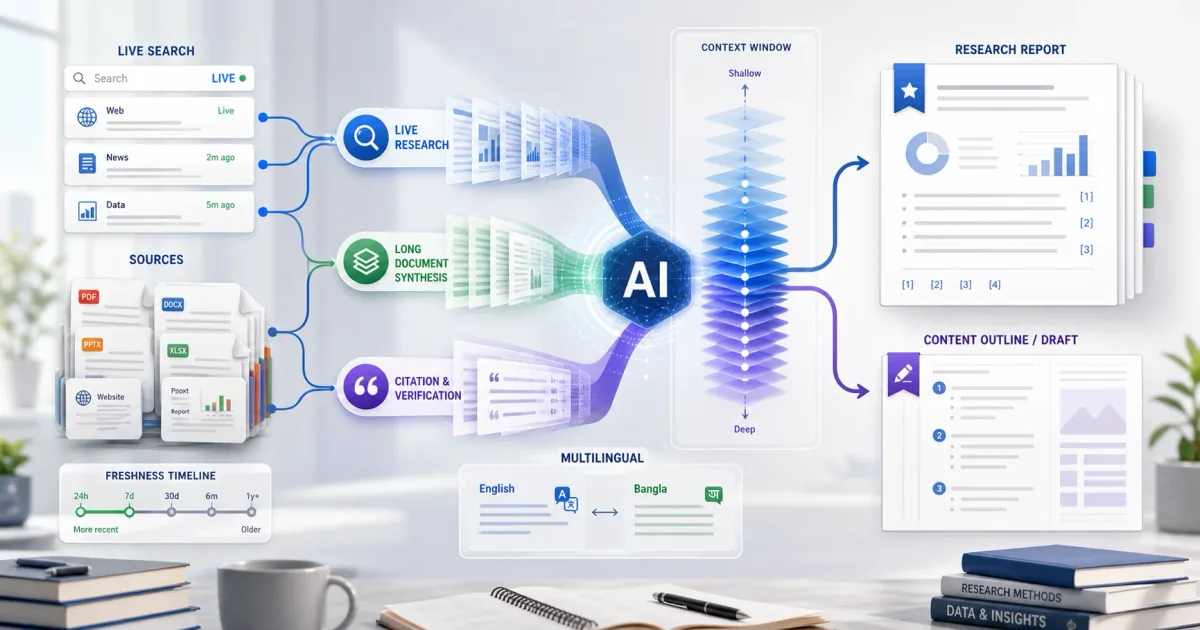
Claude's 200,000 token context window changes how document-heavy R&D work is done. A typical academic paper runs 8,000 to 15,000 words. In one session, pasting 11 research papers totaling 94,000 words and asking Claude to identify methodological contradictions between them and surface research gaps that none of the papers addressed produced a structured 2,000-word analysis in under four minutes. The same synthesis done manually would take two full workdays.
Claude also hallucinates citations less than GPT-4o, which matters for research contexts where fabricated references create real downstream problems.
Gemini for R&D
For research synthesis with live information, NotebookLM combined with Gemini is the most capable research tool of the three. Upload documents and NotebookLM creates a queryable knowledge base that synthesizes answers from your specific files with exact citations. It also generates audio discussions of your content automatically, useful for reviewing material away from a screen.
The live search grounding means Gemini can combine your uploaded document library with current web results in the same session, something Claude cannot do without a third-party tool.
Verdict: Gemini (NotebookLM) for research synthesis with live information. Claude for deep critical analysis of large existing document libraries. ChatGPT for hypothesis generation and structured review design.
6. Content Writing and Copywriting
ChatGPT for Content Writing
ChatGPT is the most versatile content model across format types and industries. Marketing copy, email sequences, social media, product descriptions, blog outlines: it handles all of them competently and fast. For high-volume, lower-stakes content where speed matters more than nuance, ChatGPT is the right call.
The weakness is a recognizable stylistic pattern: smooth but generic phrasing, predictable paragraph rhythm, and a polished-but-surface quality in long-form content. For SEO content, Google's Helpful Content system does not penalize AI generation directly, but it does penalize thin content lacking demonstrable expertise. Underprompted ChatGPT output falls into that category. Pairing AI drafts with the right SEO tools for keyword research and optimization is what closes that expertise gap.
Claude for Content Writing
Claude produces the highest quality long-form content of the three. In a test where tone, structural requirements, required entities, heading structure, and citation placement were all defined in a single system prompt, Claude followed all of them across a 3,800-word article without drift. GPT-4o abandoned the structural requirements at H3 level and dropped the citation placement rules entirely in the third section.
Claude also avoids the filler phrases that editors routinely strip from GPT-4o drafts ("In today's rapidly evolving landscape," "It is worth noting that"). The copy is tighter by default, without prompting for it.
Contrarian take: For copy that needs edge or urgency, Claude self-softens. During RSAutomart's flash sale campaign, Claude wrote safe, functional banner copy. ChatGPT wrote three options and one had a hook that was sharper and more action-driving than anything Claude produced. For marketing copy that needs to convert rather than inform, use ChatGPT for options and Claude for polish and structural consistency. For how content quality affects search rankings, see how search engines evaluate and rank content.
Gemini for Content Writing
Gemini's content advantage is factual currency. For content types where recency matters (industry reports, trend analysis, current market data), Gemini pulls live statistics without you needing to supply them. For pure writing quality and tonal control, it still trails Claude.
Verdict: Claude for quality, SEO optimization, and voice consistency. ChatGPT for volume, versatility, and marketing copy. Gemini for factually current, research-heavy content.
7. Bangla and Multilingual Content
| Model | Bangla Performance | Notes |
|---|---|---|
| ChatGPT | Best of three | Largest multilingual training data, handles Bangla grammar and Bangla-English (Banglish) naturally |
| Gemini | Strong | Google Translate integration improves output; handles Bangla search queries well |
| Claude | Adequate | Works for straightforward Bangla tasks; less reliable on idiomatic phrasing |
For SEO content targeting Bangladeshi audiences in Bangla, ChatGPT is the strongest option. For mixed Bangla-English content common in Bangladeshi social media and marketing, ChatGPT handles register switching more naturally than the other two. Claude is the weakest of the three for Bangla-specific content and should not be the first choice for audience-facing Bangla copy.
Common Mistakes When Choosing an AI
- Trusting benchmark scores over real project tests. MMLU and HumanEval scores measure performance on standardized test sets, not your actual workflow. SSLCommerz is not in any benchmark. That is exactly the kind of task that separates models in real work. Always test on your specific tasks before committing to a model.
- Single-model loyalty. The switching cost between models is zero. Professionals who default to one tool out of habit or familiarity leave quality on the table on every task that model is not best suited for.
- Blaming the model when the prompt is weak. The
AGENTS.mdfile in the RSAutomart repository exists because Claude was writing incorrect Next.js 16 code based on stale training data. The fix was not switching to a different AI. It was directing Claude to read the framework documentation before writing code. Prompt engineering solved a problem that would have been misdiagnosed as a model limitation. - Ignoring context window limits. Claude Opus at 200k tokens can hold a large codebase in context simultaneously. This is why architectural consistency was maintained across RSAutomart's 9 backend route groups. Forcing a complex codebase through a smaller context window produces inconsistent output and hours of debugging regressions.
- Using Claude Opus when Sonnet is sufficient. Claude Opus is three to five times more expensive than Sonnet via API. For most content writing and straightforward coding tasks, Sonnet produces comparable quality at a fraction of the cost. Reserve Opus for architecture decisions, complex debugging, and tasks where precision is the priority.
Conclusion
Gemini, ChatGPT, and Claude are the three most capable general-purpose AI platforms available in 2026, and each has a distinct profile that maps to different work:
- Claude wins on precision, code quality, instruction adherence, and long-form content. The highest ceiling for professional work where output consistency matters more than speed.
- ChatGPT wins on versatility, ecosystem, algorithm reasoning, multilingual capability, and speed for quick tasks. The most accessible model for general professional and creative work.
- Gemini wins on real-time research, Google Workspace automation, and large document synthesis. Non-negotiable if your workflow is Google-native.
If you can only remember three rules: research first with Gemini because it has real-time data and you cannot plan without current information; build with Claude because for anything complex or production-grade its precision compounds across the project lifecycle; fill the gaps with ChatGPT for creative tasks, multilingual content, and quick scripts where flexibility matters more than precision.
The AI you use does not matter as much as understanding what each one does well and routing accordingly.
Frequently Asked Questions
Is Claude better than ChatGPT for coding?
Claude is better for complex, multi-file projects where architectural consistency and code maintainability matter. ChatGPT's o3 model outperforms Claude on standalone algorithm challenges and competitive-style math problems. For production application development, Claude produces cleaner, more reliable output and requires fewer revision cycles.
Which AI handles third-party APIs with limited documentation?
Claude, when given the official documentation directly in context. During the RSAutomart build, SSLCommerz (Bangladesh's most widely used payment gateway) was almost absent from all three models' training data. Claude processed the documentation and wrote a complete, working integration. ChatGPT invented field names that did not exist in the actual API.
Which AI is best for content writing in 2026?
Claude produces the highest quality long-form content: it follows complex structural and style instructions without drift, writes with fewer detectable AI patterns, and maintains logical flow across long articles. ChatGPT is faster and better for high-volume content or marketing copy needing urgency. Gemini is the best choice when content requires current statistics from live web sources.
Which AI is best for image generation?
ChatGPT is the strongest of the three for image generation. Its native generation through DALL-E and GPT-4o renders text inside images most accurately and follows detailed prompts most closely. Gemini is a capable second through Imagen, especially for photorealistic output. Claude does not generate images at all, so it is not an option for this use case.
Which AI is cheapest for developers building automation?
Gemini 1.5 Flash at approximately $0.075 per million input tokens is significantly cheaper than GPT-4o ($2.50) or Claude Sonnet ($3). For high-volume automation pipelines where quality can be slightly lower, Gemini Flash offers the best cost-to-performance ratio. Check official pricing pages for current rates as they change frequently.
Which AI works best for Bangla content writing?
ChatGPT is the strongest model for Bangla and Bangla-English (Banglish) content. It handles idiomatic phrasing and the register switching common in Bangladeshi social media naturally. Gemini performs adequately for straightforward Bangla tasks. Claude is the weakest of the three for Bangla-specific content.
Is Claude Pro worth $20/month for freelancers?
For freelancers doing professional work across coding, automation, SEO content, or AI product building, Claude Pro is worth the cost. The jump from the free tier's strict message limits to Pro's higher-usage Opus access is significant for daily professional work. If your primary use is quick queries and casual writing, the free tiers of ChatGPT or Gemini cover most needs without a subscription.
Which AI is best for n8n automation workflows?
Claude for writing the Python or TypeScript logic inside n8n nodes, particularly for production workflows needing reliable error handling and retry logic. ChatGPT for HTTP request module configurations and integrations with well-documented external APIs. Gemini for any Sheets-connected automation on the Google Workspace side.
Can I build a full e-commerce site using AI assistance?
Yes. RSAutomart is a working example: a full Next.js frontend, Express.js backend, MongoDB, SSLCommerz payment integration, and Cloudinary image management, all built with significant AI assistance across Claude, ChatGPT, and Gemini. The key is knowing which model to use at each phase rather than defaulting to one AI for everything.